

What technical specifications do Seeketing nodes have?
Seeketing nodes are IoT devices designed to analyze people’s behavior in physical spaces (streets, stores, events, cities, etc.), connecting that behavior with the digital world. Technically, their specifications are not presented as a “classic hardware spec sheet” (CPU/RAM type), but rather as technological and operational capabilities.
 Communication technologies
- They combine multiple wireless technologies:
- Cellular
- WiFi
- Bluetooth
- Signal detection across multiple bands:
- 125 kHz, 13 MHz
- 840–960 MHz
- 2.4 GHz, 3.6 GHz, and 5 GHz
 This enables them to detect mobile phones even in scenarios where other technologies fail.
 Detection capability
- They detect between 85%–90% of mobile devices in their area
- Visitor identification:
- Unique
- Anonymous (GDPR-compliant)
- They do not depend on:
- Installed apps
- The user’s WiFi connection Key advantage over iBeacon or traditional WiFi tracking.
 Coverage
- Configurable coverage depending on the technology:
- From ~3 m² up to 15,000 m² per node (WiFi/Bluetooth)
- Up to several km² using the cellular network
They can be used both indoors and outdoors.
 Installation and power
- Plug & play devices (quick installation)
- Operation:
- With mains power (125/220V)
- Some associated sensors can run on battery
 Processing and identification
- They generate a unique visitor ID by combining offline and online data
- They enable:
- Recurrence tracking (repeat visits)
- Behavior analysis (dwell time, routes, etc.)
- They avoid typical issues such as:
- WiFi randomized MAC addresses
Communication features
- Proximity messaging:
- SMS / WhatsApp
- Push notifications (if there is an app)
 Types of data they generate
- People flow (origin-destination)
- Visitor volume
- New vs. returning
- Areas of interest
- Dwell time
 Integration and architecture
- Integration with:
- Web
- Mobile apps (iOS, Android, HTML5 SDK)
- Analytics and BI platforms
- Omnichannel system (online + offline)
 Complementary sensors and devices
Nodes can work alongside:
- Counting sensors (footfall type)
- Remotely managed iBeacons
Is Seeketing a good option for retail?
What does each technology measure?
Computer vision cameras are primarily designed to:
- Count pass-by events (entries/exits)
- Measure flow
- Calculate real-time occupancy
- Cameras do not count unique people; they count visits/events.
And that is why:
- Cameras → how many times someone enters
- Seeketing → who (approximately) enters and whether they return
 Cameras
 Total traffic (visits)
- Conversion (if you cross-reference with sales)
 Unique people (in general)
Seeketing- Unique people (estimated by device)
- Recurrence (who returns another day)
- Visit frequency
- Exact physical counting of entries
Which technologies offer both unique visitor counting and opportunity counting?
1. Computer vision + Re-identification (Re-ID)
What it is
AI-powered cameras that apply Re-identification (Re-ID)
 What it measures
- Total entries (opportunities)
- Unique visitors (deduplicated)
- Recurrence (if they return)
- Routes and zones
- Dwell time
 How it works
- Detects people using computer vision
- Extracts features (clothing, silhouette, movement)
- Generates an anonymous ID
- Re-identifies the same person at different times/cameras
Result:
if they enter at 10:00 and at 12:00 → it counts 1 unique person and 2 visits
It is designed specifically to solve the problem you mentioned.
 In fact, it enables “deduplicated unique counting,” avoiding double counting.
 Pros / Cons
Very accurate (almost census-level) Does not depend on a mobile phone GDPR-compliant (no biometrics) More expensive Requires good camera installation
2. WiFi / Bluetooth tracking → partial hybrid
 What it is
Tracking of mobile devices (MAC, signals)
What it measures
- Unique visitors (by device)
- Recurrence
- Dwell time
 Limitation
- Does not measure the true total number of people well
- Depends on having an active mobile phone
That is why:
- It is good for unique visitors
- Poor for real opportunities
In addition, it loses accuracy today due to privacy (randomized MAC addresses).
 3. Hybrid systems (vision + WiFi) → the most used in large retail
Typical example: FootfallCam
How they work
They combine:
 Cameras → total counting (opportunities)
- WiFi → identification of unique devices
Literally:
- video = “footfall count”
- WiFi = “returning customers”
What they achieve
- Total traffic (very accurate)
- Unique visitors (estimated)
- Recurrence
- Dwell time
It is the standard for many mid-sized/large retailers.
Clear comparison
| Technology | Opportunities (visits) | Unique people | Overall accuracy |
|---|---|---|---|
| Basic cameras | | | High (traffic only) |
| WiFi / Bluetooth | | | Medium |
| Seeketing | estimated | | High for unique visitors |
| Re-ID (advanced vision) | | |  Very high Very high |
| Hybrid (vision + WiFi) | | | High |
What does Seeketing offer?
How many people without a mobile phone can enter a store today in any Western country?
Europe / Western countries
- ~85–91% of adults have a smartphone
- ~98% have some type of mobile phone (including non-smartphones)
- Only ~3–10% do not have any mobile phone
Direct translation:
- People without a mobile phone → very few (≈3–10%)
- People without a smartphone → somewhat more (≈10–15%)
In cities (typical retail)
- Up to 89% actively use a smartphone
In realistic urban retail:
- 90%+ carry a smartphone
- But that does NOT mean everyone is detectable
- Why “having a phone” ≠ “being measured”
Even with 90% smartphones:
 Non-detectable cases
- Phone with WiFi/Bluetooth turned off
- Airplane mode
- Randomized MAC (very common today)
- Weak signal / interference
- User with multiple devices
- People who are not carrying their phone (less frequent, but it happens)
Real outcome:
- WiFi / Seeketing-type systems do not detect 100%
- They typically remain at: 70–90% coverage (estimated)
So, in a real store:
Typical scenario (Europe, urban retail)
Out of 100 people who enter:
- ~90 have a smartphone
- ~70–85 are correctly detectable
- ~15–30 are not detected or are modeled
Can I use Seeketing to get data from 90% of the people who enter a store?
With Seeketing, you can have data for approximately 70%–90% of visitors,
but it is not a guaranteed or uniform 90%.
Why it is NOT always 90%
Even if many people have a phone, actual detection depends on several factors:
 Factors that reduce coverage
- WiFi and Bluetooth turned off
- Privacy systems (randomized MAC)
- Weak signals or interference
- People with multiple devices (distorts data)
- People who are not carrying their phone
This means that:
having a phone ≠ being detectable
What happens in practice (real retail)
In a typical store in Europe:
- 100 people enter
- ~90 carry a smartphone
- ~70–85 are reliably detected
- ~15–30 are excluded or modeled
Result:
Seeketing works with a large sample, but not a complete one
How to interpret that 70–90%
This is key:
Seeketing is NOT a census counter It is a highly robust statistical system
That means:
- Very good for:
- Trends
- Comparisons (day vs. day, store vs. store)
- Recurrence
- behavior
- Less reliable for:
- Exact entry counting
- Absolute KPIs without calibration
 Practical example
Imagine:
- Seeketing detects 800 “unique visitors”
- In reality, 1,000 people entered
You do not know the exact number… But you do know:
- How many return
- How long they stay
- How traffic evolves
How companies solve it
Serious implementations do this:
combine Seeketing + physical counting (cameras/laser)
This way you get:
- Cameras → 1,000 real entries
- Seeketing → behavior of ~800 people
And you can scale/correct the data
Which is more accurate at counting people?
In a real retail scenario (employees + customers who enter multiple times per day):
- Traditional cameras (entry counting only)
- Each entry is counted as “one person,” even if it is the same person multiple times.
- Result: overestimation, because it does not distinguish duplicates.
- Example: 1 employee enters 5 times → 5 “people” in the count.
- Conclusion: it is not accurate for unique people.
- Seeketing (unique device detection)
- Each detected mobile device is associated with a unique ID.
- Result: it approximates the real number of different people much better, because duplicates (the same person entering multiple times) are counted only once.
- Limitation: it does not detect people without a phone or phones that are not detectable, so it may slightly underestimate.
- Typical coverage: ~70–90% of all people who enter.
Conclusion
- To count unique people, Seeketing is more accurate than cameras.
- Cameras only measure visits, and therefore overestimate the number of people when the same person enters multiple times.
- Seeketing slightly underestimates due to people without a phone, but it still provides a better approximation of the real number of distinct individuals.
Example scenario
Suppose a store in one day:
- Unique customers: 100
- Employees: 10
- Entry frequency:
- Each customer enters once
- Each employee enters 5 times (exits and re-entries)
 Counting with cameras (entries only)
- Cameras count all entries:
Type People/entries Comment Customers 100 Each customer enters once Employees 10 x 5 = 50 Each employee enters 5 times Total counted by cameras 150 Overestimates unique people Note: Cameras do not distinguish duplicates, so the real number of unique people is 110, but cameras report 150. Counting with Seeketing (detectable unique people)
- Assuming 80% detection of people with a phone:
Type Real people Detected (~80%) Comment Customers 100 80 Detected with their phones Employees 10 8 Detected with phones Total detected by Seeketing 88 Approximately unique people Note: Seeketing slightly underestimates (people without a phone or not detectable), but it removes duplicates, so it reflects unique people much better.Direct comparison
Metric Cameras Seeketing Real number of unique people Unique people 150 88 110 Error vs. real unique people +36% (overestimates) -20% (underestimates) 0% Interpretation
- Cameras: overestimate unique people when there are multiple entries (employees, customers who go out and come back in).
- Seeketing: slightly underestimates due to non-total coverage, but it is much more accurate for measuring unique people.
- In scenarios with many multiple entries, Seeketing will always be closer to the real number of distinct people than cameras.
Rule of thumb for retail
- Goal: measure unique visitors → Seeketing
- Goal: measure sales opportunities → Cameras
- Combine both systems → the best possible approximation: unique people + real visits.
How many different people pass by, and how many times does each person enter?
Key metrics that truly matter
- Unique people
- How many distinct individuals have entered the store over a period.
- This includes customers + employees, but without duplicates.
- It enables measurement of real reach and customer penetration.
- Visits per person (frequency)
- How many times each person enters during the day, week, or month.
- This makes it possible to identify recurrence, employees who generate multiple entries, and real customer behavior.
Why traditional systems fail
- Simple cameras → only count footfall/entries
- Problem: 1 person entering 5 times = 5 people → overestimation
- Children playing, employees going in and out → distorts data
- Simple WiFi tracking → only detects devices
- Problem: phones off, randomized MACs → underestimation
- It only captures part of the audience
The real solution in retail
To answer “how many distinct people pass by” and “how many times each person enters”, you need:
- A unique-person identification system
- Example: Seeketing (unique device ID)
- Advantage: removes duplicates, measures recurrence, differentiates customers from employees.
- Complementary physical counting (cameras, laser, sensors)
- Ensures full coverage of real entries.
- Corrects undercounting of people without a phone.
How are they combined?
| Metric | Ideal technology |
|---|---|
| Unique people | Seeketing (detected devices) |
| Frequency/recurrence | Seeketing |
| Real entries/visits | Cameras/laser |
| Final KPI: conversion per person |
|
 Insight
The real value in retail is not in counting footfall, but in:
- Knowing how many distinct individuals enter
- Knowing how many times each one enters
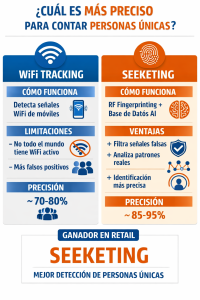
Is WiFi tracking different from Seeketing, which uses a trained knowledge database with radio-frequency signal patterns and fingerprinting techniques?
Classic WiFi Tracking
How it works:
- Detects WiFi signals from nearby smartphones (probe requests)
- Each device has a MAC address, which is used as an identifier
- People count = each MAC → one “person”
Limitations:
- Many smartphones use randomized MAC, which makes persistent identification difficult
- It only detects devices with WiFi enabled
- It does not reliably distinguish recurrence, frequency, or real behavior patterns
- It does not use prior learning or behavior models
The good:
- Low cost, easy to install
- Provides traffic trends (footfall)
The bad:
- Low accuracy for unique people
- Privacy issues (MAC tracking without anonymization)
Seeketing
How it works:
- Detects radio-frequency signals (WiFi, Bluetooth, cellular, etc.)
- Uses fingerprinting and signal patterns to identify devices persistently
- It relies on a knowledge base trained on millions of patterns → it can better differentiate between different devices
- Generates a unique anonymous ID for each visitor
- Able to detect recurrence, entry frequency, dwell zones, etc.
Advantages over classic WiFi tracking:
- It does not depend on WiFi being enabled (it can use other signals)
- It recognizes devices better even if they change MAC or there is signal noise
- High accuracy for unique people and behavior
- GDPR-compliant because the IDs are anonymous and persistent
 Key differences summary
| Feature | Classic WiFi tracking | Seeketing |
|---|---|---|
| Signals used | WiFi only | WiFi, Bluetooth, cellular, multiple frequencies |
| Persistent identification | Limited (randomized MAC) | High (fingerprinting + pattern database) |
| Unique people | Low accuracy | High accuracy |
| Recurrence / frequency | Limited | Yes |
| Overall accuracy | Low to moderate | High |
| Privacy | Problematic | GDPR-compliant (anonymous) |
| Infrastructure | Simple | More complex; requires a knowledge base |
Summary
- Classic WiFi tracking = a simple sensor → it only detects “visible devices”
- Seeketing = an intelligent platform → it combines sensors + AI + a pattern database to better identify visitors, measure recurrence and behavior, and generate reliable unique people
In other words:
Seeketing is an evolution of WiFi tracking, using fingerprinting techniques, pattern learning, and multi-signal analysis, focused on people analytics and real behavior, not just device counting.